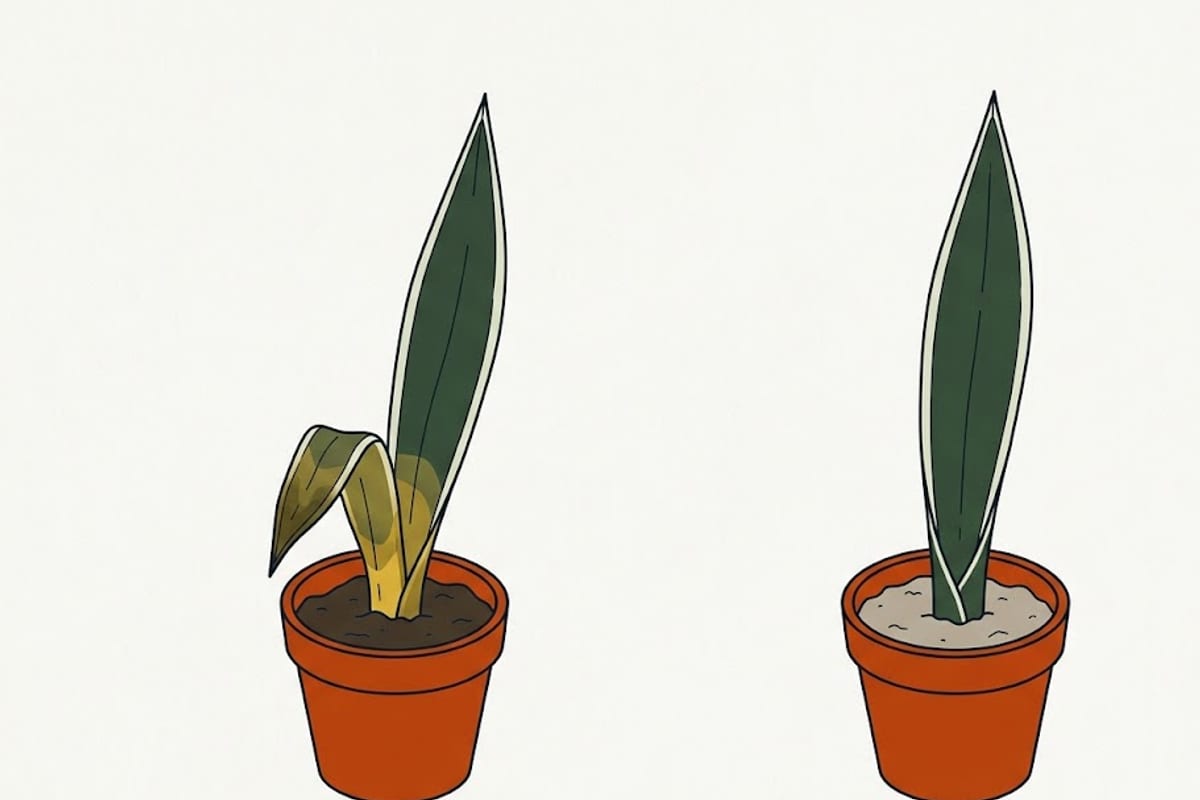
A snake plant that has gone soft, yellow or translucent at the soil line has rot at the base of the leaf, and usually in the rhizome the leaf grows from. The cause is water sitting in the soil for too long, sometimes with cold added. The soft tissue will not recover. What matters now is how far the rot has spread and how much firm tissue is left to save.
This page is about that decision. It covers how to confirm rot, how to tell it from the one thing that looks like it (cold damage), what to cut and what to keep, and how to reroot the pieces so the plant survives even when the base is lost.
What the base tells you
| What you see | Most likely cause | Check this first |
|---|---|---|
| One or two leaves soft, yellow and translucent at the soil line, folding over, soil wet | Basal rot from overwatering | Squeeze the base of every leaf; check the rhizome |
| Several leaves soft at the base, sour smell, soil wet for days | Rhizome rot spreading | Unpot now |
| Leaves mushy and dark along their length after a cold night, soil not necessarily wet | Cold damage | Where the plant sat; recent temperature |
| Base firm, leaf yellowing evenly and thinning | Not rot; light or age | Leave the base alone |
| Base firm but leaf wrinkled and curling | Not rot; underwatering | Soil dry to the bottom |
Why the base rots
Snake plants store water in their leaves and rhizomes and take it from the soil slowly. In a pot that stays wet, the rhizome and the bottom of the leaves sit in water they cannot use, the tissue suffocates, and fungi and bacteria move in. The rot begins at the soil line, where the leaf meets the rhizome, and works upward into the leaf and outward through the rhizome to the next leaf. Cold speeds it: a wet snake plant on a cold windowsill in winter can go from firm to mushy in a week.
The common paths to a wet pot: a pot without a drainage hole, a saucer that holds water, a dense peat-based mix that never dries, a pot much larger than the plant, and watering on a schedule instead of by the soil.
The squeeze test
Squeeze the base of each leaf gently between finger and thumb at the soil line. A healthy base is firm, like a green pepper. A rotting base gives, feels soft or hollow, and may be yellow, brown or translucent. Do this for every leaf, not just the one that fell over, because rot in the rhizome reaches neighbouring leaves before they show it.
Then slide the plant out of the pot and look at the rhizome, the thick horizontal stem the leaves rise from. Healthy rhizome is pale and firm. Rotted rhizome is brown, soft, and often smells sour.
Rot or cold damage
Cold damage looks similar but has a different pattern. A leaf chilled below about 10 degrees Celsius goes mushy and dark along its length, often in patches where it touched cold glass, and the damage appears within a day or two of a cold night. Rot starts at the base and works up over days to weeks, and the soil is wet. A cold-damaged leaf with a firm base can be cut back to healthy tissue; a rotted leaf must be removed at the base, and the rhizome checked.
What to cut and what to keep
Work with a clean sharp knife or scissors.
- Remove every leaf that is soft at the base. Cut it away at the rhizome. If the rhizome under it is soft, cut the soft rhizome away too, back to firm pale tissue.
- Keep every leaf whose base is firm, even if the leaf is next to a rotted one.
- For a removed leaf, look up its length. If the upper part is still firm and green, it can be rooted as a cutting (below). Discard the soft part.
- If the whole rhizome is soft, the plant as a plant is gone, but any firm leaf sections can be rooted into new plants.
Let all cut surfaces dry in the air for a day or two before they touch soil again. This callus is what stops the rot re-entering.
Repotting the survivor
Repot the firm remainder in a fresh, gritty, fast-draining mix: a cactus and succulent mix, or potting soil cut with a generous share of perlite or coarse sand. Use a pot with a drainage hole, only slightly larger than the root mass; terracotta helps because it dries from the sides. Do not water for a week. Then water thoroughly and let the soil dry completely before watering again, which in a cool or dim room can mean three to six weeks between waterings.
Rooting the cut leaves
A firm section of snake plant leaf will grow roots and, eventually, a new plant.
- Cut the leaf into sections ten to fifteen centimetres long, and mark which end was nearest the soil; only that end will root.
- Let the cuts dry for two or three days.
- Stand the soil end a few centimetres deep in barely moist gritty mix, or in a glass of water changed weekly.
- Keep warm and bright. Roots take four to eight weeks; a new shoot takes months.
Variegated types rooted from leaf sections usually lose their yellow edges and come back plain green. To keep the variegation, divide at the rhizome instead, which is only possible when some rhizome survived.
What to do today, by cause
- Rot at the base: squeeze every leaf, cut soft leaves and rhizome away to firm tissue, dry the cuts, repot in gritty mix, do not water for a week.
- Rot spread through the rhizome: root firm leaf sections as cuttings and discard the rest.
- Cold damage with a firm base: cut the leaf back to healthy tissue and move the plant away from cold glass.
- Firm base, other symptoms: the problem is not rot; look at light, age or thirst.
Frequently asked questions
Can a snake plant with a mushy base be saved?
The soft parts cannot, but the plant usually can. Cut away every leaf and every piece of rhizome that is soft, keep what is firm, let the cuts dry, and repot in gritty mix. If nothing firm is attached to the rhizome, root firm leaf sections as cuttings and you will have new plants in a few months.
Why is my snake plant mushy at the bottom but green on top?
Because rot starts at the soil line, where the leaf base sat in wet soil, and works upward. The green upper part is still healthy tissue and can be cut off above the soft zone, dried for a couple of days, and rooted as a cutting.
Should I water a snake plant after cutting off the rot?
No. Wait a week after repotting so the cut surfaces seal, then water thoroughly and let the soil dry completely before the next watering. Wet soil is what caused the rot; the plant has water stored in its leaves and will not suffer from waiting.
How do I stop snake plant rot from coming back?
A pot with a drainage hole, a gritty fast-draining mix, a pot no larger than the plant needs, and watering only when the soil is dry all the way down. In winter, keep the plant away from cold windows and water even less.