A snake plant leaf grows from its tip, and once the tip is damaged that leaf stops lengthening for good. Brown tips come from a bumped or broken growing point, from fertiliser salts, from direct sun scorch, from cold, and, less often, from soil that went too dry or stayed too wet. None of these harms the plant; the tip is cosmetic. But each one keeps producing brown tips on new leaves until it is changed, so it is worth knowing which it is.
Look at the tip: whether it is a small dry brown point, a wide bleached patch, a soft dark patch, or a crease, and whether the marks are on every leaf or only on the side facing the window.
What the tip tells you
| What you see | Most likely cause | Check this first |
|---|---|---|
| A small dry brown tip on one or a few leaves, a crease or bend below it, plant in a walkway or moved recently | Physical damage to the growing point | Where the plant sits; recent handling |
| Brown tips with a yellow band, on many leaves, white crust on the soil, recent feeding | Fertiliser salts | Soil surface; feeding history |
| Wide bleached tan patch from the tip down the side facing the window | Sun scorch | Hours of direct sun; recent move |
| Soft dark brown or translucent tip after a cold night near glass | Cold damage | Where the plant sat |
| Dry brown tips and edges on leaves that are wrinkled or curling, soil bone dry for months | Long underwatering | Soil to the bottom; leaf firmness |
| Brown soft tips with yellowing and soft bases, soil wet | Overwatering and rot | Squeeze the leaf base; root check |
Physical damage to the growing point
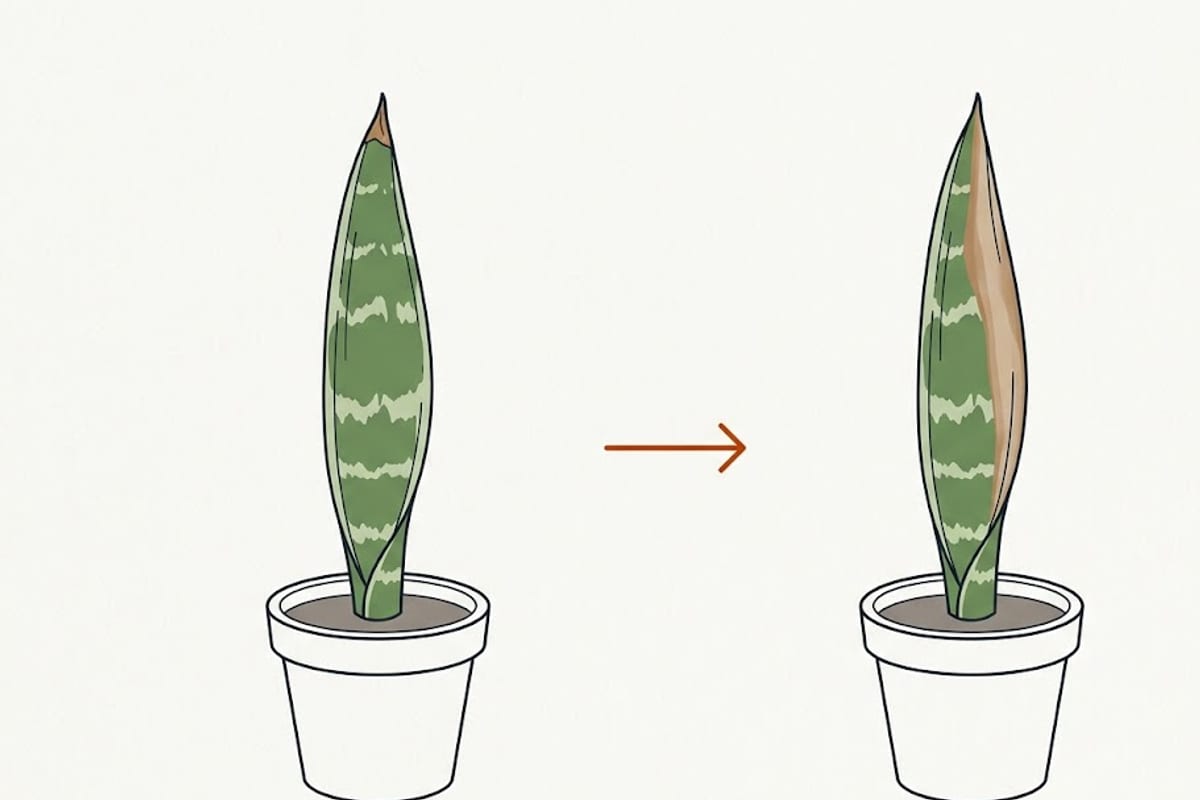
The most common cause, and the least noticed. The tip of a snake plant leaf is soft while it is growing, and a brush from a passing person, a pet, a curtain, or a knock during repotting or transport bruises it. The tip dries and browns, sometimes with a crease or bend just below it, and that leaf never grows taller. Plants in hallways, beside doors, and on floors near furniture get it most.
What to do: move the plant out of the traffic. The leaf keeps its brown tip; new leaves come up undamaged.
Fertiliser salts
Snake plants need very little feeding, and salts from fertiliser, and from hard tap water, build up in the pot and draw water from the leaf tips. The tips brown with a yellow band inside the brown, on many leaves, and a white or tan crust shows on the soil surface or the pot rim.
What to do: flush the pot by running water through it slowly until it drains clear, let it dry completely, and feed no more than two or three times a year at quarter strength. Use rainwater or filtered water if the tap water is hard.
Sun scorch
Snake plants tolerate bright light, but a plant moved suddenly into hours of direct sun through glass scorches on the side facing the light: a wide, bleached, tan patch running down from the tip, sometimes with a darker margin. The other side of the leaf stays green.
What to do: pull the plant back from the glass or filter the light, and move plants into stronger light gradually. Scorched tissue stays; new leaves are fine.
Cold damage
Below about 10 degrees Celsius the leaf tips, the thinnest part, go soft, dark and translucent within a day or two of a cold night, especially where they touched cold glass. What to do: move the plant away from cold windows in winter. Cut the damaged tip back to firm tissue and let the cut dry.
Long underwatering
Snake plants can go weeks without water, but months without it leaves the leaves wrinkled, curling and dry-tipped. What to do: water thoroughly, let it drain, and resume checking the soil every few weeks. The wrinkles ease over a couple of weeks; the tips stay brown.
Overwatering and rot
Wet soil rots the base of the leaves first, not the tips, but a leaf that is rotting at the base yellows and browns at the tip as it dies. If the tips are soft and brown and the bases are soft too, the tip is not the problem. What to do: squeeze the leaf bases; soft means rot, and the fix is cutting and repotting in gritty mix, which is covered on the snake plant mushy base page.
Trimming brown tips
A brown tip does not spread down the leaf by itself once its cause has stopped, and it does not need trimming. If you trim for appearance, cut with clean scissors following the leaf's pointed shape, leaving a hairline of brown rather than cutting into green tissue, which would seal over brown again. Never cut the tip off a leaf that is still growing and healthy; that stops it too.
What to do today, by cause
- Damage: move the plant out of the traffic; the leaf stays as it is.
- Salts: flush the pot, feed rarely, use softer water.
- Sun scorch: pull back from the glass and move into sun gradually.
- Cold: move away from cold windows, trim the soft tip.
- Long underwatering: water thoroughly and check the soil every few weeks.
- Rot: squeeze the bases; if soft, cut and repot in gritty mix.
Frequently asked questions
Will a snake plant leaf with a brown tip keep growing?
No. A snake plant leaf grows from its tip, and a browned or damaged tip means that leaf has finished lengthening. The leaf stays healthy otherwise, and the plant keeps making new leaves from the rhizome.
Should I cut brown tips off a snake plant?
Only for appearance. Cut following the leaf's pointed shape and leave a thin line of brown so the cut does not brown again. Cutting a healthy growing tip stops that leaf, so leave green tips alone.
Why does my snake plant keep getting brown tips on new leaves?
Because the cause is still there: the plant is being brushed in a walkway, the soil holds fertiliser salts, or the leaves scorch on the window side. Move it, flush the pot, or pull it back from the glass, and the next leaves come up clean.
Are brown tips a sign my snake plant is overwatered?
Usually not. Overwatering shows first as soft yellow leaf bases and leaning leaves, not as dry brown tips. If the tips are brown and soft and the bases are soft too, the leaf is rotting from the base; check the bases and the roots.