Almost every spider plant gets brown tips eventually, and the cause is one of five: fluoride and chlorine in tap water, dry air, fertiliser salt buildup, direct sun, or a pot so full of roots that the plant cannot hold water. The shape of the tip and the state of the soil say which. Thin dry tips on nearly every leaf point at the water or the air; tips with a yellow band and a crust on the soil point at salts; wide scorched patches on one side point at the window; roots pushing out of the pot point at the pot.
What the tip looks like and where it is
| What you see | Most likely cause | Check this first |
|---|---|---|
| Thin dry brown tips on most leaves, plant otherwise healthy, watered from the tap | Fluoride and chlorine in tap water | Water source |
| Brown tips with a yellow band inside them, white crust on the soil, recent feeding | Fertiliser salt buildup | Soil surface; feeding history |
| Tips and edges brown, leaves limp, soil dry, plant near a heater or vent | Dry air and underwatering | Soil to the bottom; position |
| Wide tan scorched patches along the leaves on the window side | Too much direct sun | Hours of direct light |
| Roots pushing out of the drainage hole, water running straight through, tips browning | Root bound and overcrowded | Slide the plant out |
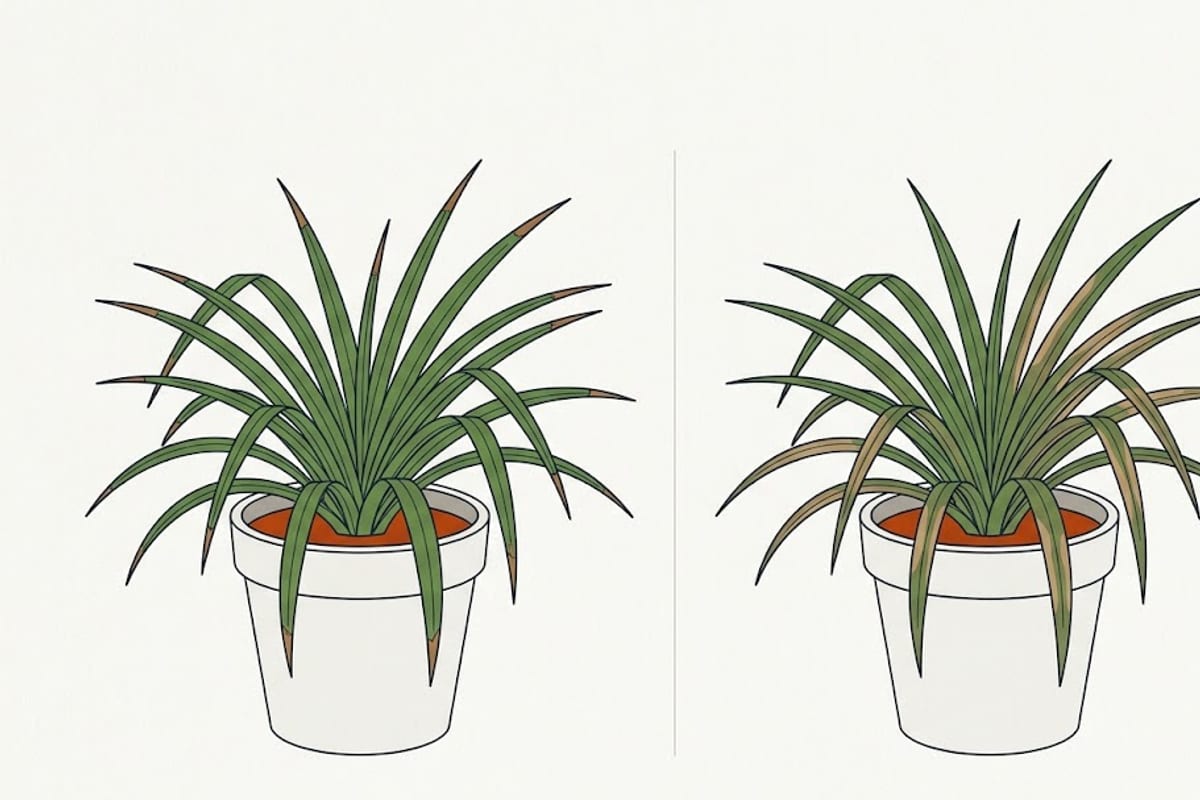
Fluoride and chlorine in tap water
Spider plants are among the most fluoride-sensitive houseplants. Fluoride and chlorine in tap water accumulate at the leaf tips, the end of the water's journey, and kill the tissue there in a thin dry brown line on nearly every leaf. Letting tap water stand overnight lets chlorine escape but does not remove fluoride.
What to do: water with rainwater, distilled water or filtered water, and flush the pot with plenty of it every month or two. New leaves come in clean; old tips stay brown.
Dry air and underwatering
In dry winter air near a radiator or a heating vent, the leaf tips lose water faster than the plant supplies them and dry brown. A plant that goes dry too long does the same, with limp leaves and soil shrunk from the pot.
What to do: move the plant away from heat sources, group it with other plants or use a humidifier, and water thoroughly when the top few centimetres of soil are dry. Misting wets the leaf briefly and is not a fix.
Fertiliser salt buildup
Fertiliser is a salt, and salts that are never flushed from the pot draw water out of the leaf tips. The tips brown with a yellow band inside the brown, often within a week or two of feeding, and a white or tan crust shows on the soil surface or pot rim.
What to do: flush the pot slowly with plenty of water until it drains clear, and feed at half strength no more than monthly in spring and summer.
Too much direct sun
Spider plants want bright indirect light. Hours of direct sun through glass scorch wide tan patches along the leaves on the side facing the window. What to do: move the plant back from the glass or filter the light.
Root bound and overcrowded pots
A spider plant fills its pot with thick roots within a year or two. Once the pot is solid roots, water runs straight through, the plant dries in a day, and the tips brown from the repeated thirst. Roots push up through the soil and out of the drainage hole.
What to do: repot one or two sizes up in fresh mix, or divide the plant into two or three clumps.
Cutting the tips without harm
Brown tips do not spread once their cause has stopped and do not harm the plant. If you trim for appearance, use clean scissors and cut following the leaf's natural pointed shape, leaving a hairline of brown rather than cutting into green tissue, which would brown again. Trimming does not stop new tips if the cause remains.
What to do today, by cause
- Tap water: switch to rainwater or filtered water, flush the pot.
- Dry air or thirst: move away from heaters, water when the top is dry, raise humidity.
- Salts: flush the pot, feed less.
- Direct sun: move back from the window.
- Root bound: repot or divide.
Frequently asked questions
Should I cut the brown tips off my spider plant?
Only for appearance. Cut following the leaf's shape and leave a thin line of brown so the cut does not brown again. Trimming does nothing about the cause.
Can brown tips on a spider plant turn green again?
No. Dead tissue does not recover. Once the cause is fixed, new leaves come in without brown tips and the old ones can be trimmed.
Is tap water bad for spider plants?
Often, yes. Spider plants are sensitive to the fluoride and chlorine in many tap supplies, and tap water is the most common single cause of brown tips on them. Rainwater, distilled or filtered water fixes it.
Why does my spider plant get brown tips even when I water it?
Because the cause is in the water itself, in salts from feeding, in dry air, or in a pot so full of roots that the water runs through without wetting them. Check the water source, the soil surface for crust, and the roots.