A rubber plant (Ficus elastica) curls its leaves when the leaf is losing water faster than the roots supply it, and it loses or lacks water for a few distinct reasons. Dry soil curls the leaves inward and lets them droop. Dry hot air curls the edges under and browns them. Roots damaged by overwatering curl and yellow the leaves in a wet pot. Cold shocks the leaves into curling for a few days. And every new leaf emerges rolled tightly inside a red sheath and unrolls over a week, which is not a problem at all.
Look at the direction of the curl, the state of the leaf edge, whether the curl is on new leaves only, and how the soil feels.
What the curl tells you
| What you see | Most likely cause | Check this first |
|---|---|---|
| Leaves curling inward along their length and drooping, soil dry, pot light | Underwatering | Soil to the bottom; pot weight |
| Edges curling under with thin crisp brown margins, plant near a heater, vent or hot window | Low humidity and heat | Position |
| Curling with yellowing lower leaves, soil wet days after watering, sour smell | Overwatering and root damage | Root check |
| Curling and drooping after a cold night or a move, soil neither wet nor dry | Cold or shock | Temperature; recent changes |
| Only the newest leaf curled, tightly rolled or partly unrolled, older leaves flat | A new leaf unfurling | Wait a week |
| Curling with stippling, webbing, sticky film or cottony spots | Pests | Undersides of leaves and leaf stalks |
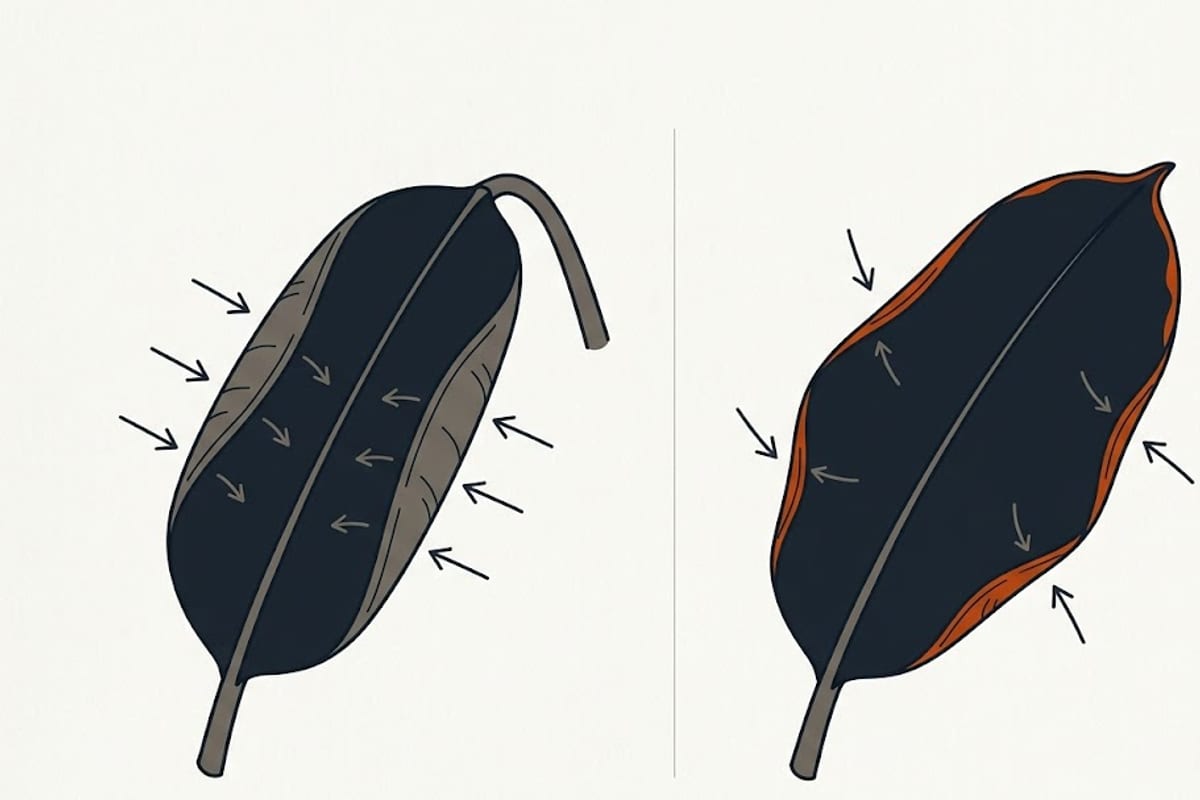
Underwatering
A rubber plant that goes dry rolls its leaves inward to reduce the surface losing water, and the leaves droop from their stalks. The soil is dry to the bottom, the pot is light, and if it has been dry a while the soil has shrunk from the pot's rim so water runs down the gap.
What to do: water thoroughly until it runs from the drainage hole. If the soil has shrunk from the rim, stand the pot in a basin of water for twenty to thirty minutes so the root ball rewets from below. The leaves flatten and lift within a day or two. Then check the soil by finger weekly and water when the top few centimetres are dry.
Low humidity and heat
Rubber plants tolerate ordinary rooms, but next to a radiator, a heating vent or a hot window the leaf edges dry out, brown in a thin crisp line, and curl under. The soil may be perfectly moist. The marks are on the leaves nearest the heat.
What to do: move the plant away from the heat source or filter hot sun with a sheer curtain. Grouping plants or running a humidifier helps in a very dry room; misting does not. Existing brown margins stay; new leaves come in flat.
Overwatering and root damage
In soil that stays wet, rubber plant roots suffocate and rot, and a plant with dead roots cannot move water to its leaves even in a wet pot. The leaves curl and droop, the lower ones yellow and drop, and the soil is wet days after watering and may smell sour.
What to do: slide the plant out of its pot. Healthy roots are white to tan and firm; rotted ones are brown, soft and pull apart. Trim rotted roots, remove the old soil, repot in fresh airy mix in a pot with drainage, and water only when the top few centimetres are dry. Recovery takes several weeks.
Cold and shock
A rubber plant chilled by a cold window, a draft from an outside door, or a night below about 15 degrees Celsius curls and droops its leaves within a day. So does a plant recently moved to a new spot or repotted, for a week or two, while it adjusts.
What to do: move it away from cold glass and drafts, keep it in one bright spot, and give it two weeks. Leaves that went dark and soft from a hard chill are lost; the rest recover.
A new leaf unfurling
Each new rubber plant leaf grows inside a red or pink sheath at the tip of the stem and emerges tightly rolled. It unrolls and flattens over about a week and the sheath dries and drops. A new leaf that stays rolled for much longer than that, or that comes out creased and small, points at underwatering or dry air during unfurling.
What to do: nothing, unless it persists beyond a couple of weeks, in which case check the soil and the air.
Pests
Spider mites, scale and mealybugs distort and curl rubber plant leaves as they feed. Look for fine stippling and webbing on the undersides, brown bumps along the leaf stalks and midribs, white cottony specks in the joints, and a sticky film on the leaves.
What to do: wipe the plant down, treat with insecticidal soap or horticultural oil on both leaf surfaces, repeat weekly for a month, and isolate it.
The soil and root checks
Press a finger into the soil to the second knuckle: dry means water, wet means look at the roots. Lift the pot: light means dry, heavy means wet. If the soil is wet and the plant is curling, slide it out and look: white and firm roots are healthy and the cause is elsewhere; brown and soft roots are rot.
What to do today, by cause
- Underwatering: soak thoroughly, rewet from below if the soil has shrunk, check weekly by finger.
- Dry air or heat: move away from heaters, vents and hot glass.
- Overwatering: unpot, trim rotted roots, repot in airy mix, water only when the top is dry.
- Cold or shock: move to a warm steady spot and wait two weeks.
- New leaf: wait a week.
- Pests: wipe, treat weekly for a month, isolate.
Frequently asked questions
Will curled rubber plant leaves flatten out again?
Leaves curled from thirst flatten within a day or two of a thorough watering. Leaves curled from cold or shock recover over a week or two once the plant is settled. Edges that browned and curled under from dry air stay as they are; new leaves come in flat once the plant is away from the heat.
Why are my rubber plant's new leaves curled?
Because every new leaf emerges tightly rolled inside a sheath and takes about a week to unroll and flatten. That is normal. If a new leaf stays rolled for several weeks or opens small and creased, the plant was short of water or in dry air while it was unfurling.
How do I know if my rubber plant is overwatered or underwatered?
By the soil and the pot. Dry soil and a light pot with inward-curled drooping leaves is thirst. Wet soil days after watering, a heavy pot, yellowing lower leaves and curling is overwatering, and the roots will be brown and soft when you slide the plant out.
Does misting help a rubber plant with curling leaves?
No. Misting wets the leaf for a few minutes and does not change the soil or the air. Water the soil if it is dry, move the plant away from heat if the edges are crisp, and use a humidifier if the room is very dry.