A peace lily turns yellow for four main reasons, and the pattern of the yellow tells you which. One old outer leaf yellowing at a time is normal. Many leaves yellowing at once, with wet soil and a sour smell, is overwatering and root rot. Yellow with brown tips and a yellow band inside them is tap water or fertiliser salts. Bleached yellow patches on the leaves facing a window are too much direct light. Two smaller causes, repeated wilting from underwatering and hunger in old soil, yellow leaves too.
Look at which leaves are yellow, whether the soil is wet or dry a few centimetres down, and, if the soil is wet, what the roots look like.
What the pattern tells you
| What you see | Most likely cause | Check this first |
|---|---|---|
| One old outer leaf yellow, the rest firm and green, new leaves forming | Old leaf dying naturally | Nothing else changed |
| Many leaves yellow at once, soil wet days after watering, stems dark at the base, sour smell | Overwatering and root rot | Root check |
| Yellow with limp leaves and brown crisp edges after the plant has wilted many times | Underwatering and repeated wilting | Soil dryness; how often it collapses |
| Yellow with brown tips and a yellow band inside them, white crust on the soil | Tap water, fluoride and salts | Water source; feeding |
| Bleached yellow patches on leaves facing the window | Too much direct light | Hours of direct sun |
| Whole plant pale, small new leaves, same soil for years | Nutrient shortage | Last feed; last repot |
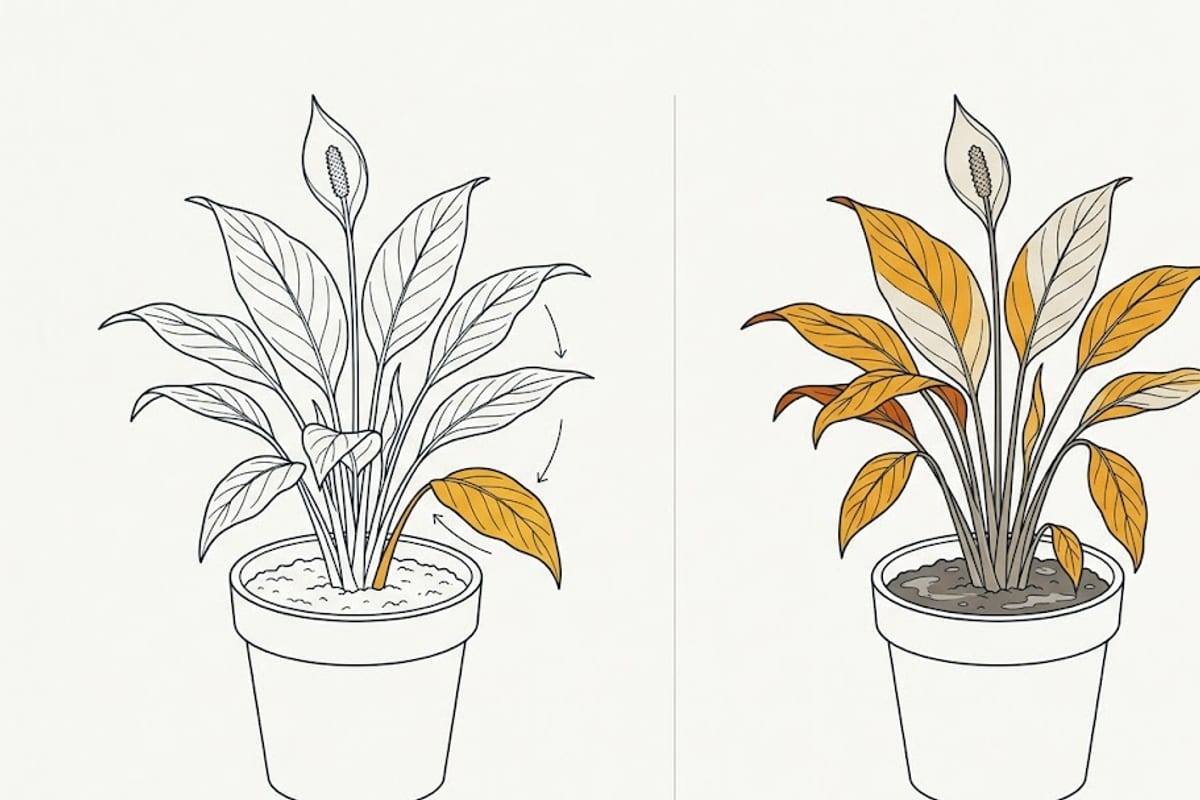
Overwatering and root rot
Peace lilies are sold as plants that love water, and many are killed by it. In soil that stays wet, the roots suffocate and rot, and the plant yellows the leaves it can no longer supply, several at once, from the outside of the plant inward. Leaf stems darken and soften at the soil line, the pot is heavy, and it smells sour.
What to do: slide the plant out. Healthy roots are white to pale tan and firm; rotted ones are brown, soft, and slide apart. Cut all soft roots back to firm tissue, remove the old soil, and repot in fresh airy mix in a pot with drainage, no larger than the roots need. Water once to settle the mix, then not again until the top of the soil is dry. Remove leaves that are more than half yellow. New roots form in two to four weeks.
Underwatering and repeated wilting
A peace lily collapses dramatically when its soil dries and stands up within hours of a drink, which trains owners to water by wilt. Every collapse damages fine roots, and a plant that wilts weekly yellows its older leaves, browns their edges, grows smaller, and flowers less over a year.
What to do: water before it wilts. Check the soil by finger every few days and water thoroughly when the top two or three centimetres are dry. If it has already collapsed and the soil has shrunk from the pot rim, stand the pot in a basin of water for twenty to thirty minutes to rewet the root ball from below.
Tap water, fluoride and salts
Peace lilies are sensitive to the chlorine and fluoride in tap water and to the salts in fertiliser. The tips brown, a yellow band forms inside the brown, and the marks appear on many leaves; a white crust on the soil surface is the salt itself.
What to do: water with rainwater, distilled or filtered water, flush the pot with plenty of water every month or two so it drains clear, and feed at quarter strength only in spring and summer.
Too much direct light
Peace lilies grow on shaded forest floors. Several hours of direct sun through glass bleach the leaves that face it to pale yellow and scorch brown patches into them. What to do: move to bright indirect light, an east window or back from a south one. Bleached leaves stay; new leaves are fine.
Old leaves dying naturally
The oldest leaves on the outside of the clump yellow and die one at a time as the plant grows new ones in the centre. If the rest is firm and green, nothing is wrong. What to do: cut the leaf at the base once fully yellow.
Nutrient shortage
A peace lily in the same soil for years with no feeding pales all over and makes small new leaves. What to do: feed at half strength monthly in spring and summer, or repot into fresh mix.
The root check
When the soil is wet and several leaves are yellow, look at the roots before changing anything else. Tip the pot, support the crown, and slide the root ball out. White, firm roots mean the roots are fine and the cause is elsewhere; brown, soft roots mean rot and the repot above is the fix.
What to do today, by cause
- Overwatering: unpot, trim rotted roots, repot in airy mix, water only when the top is dry.
- Repeated wilting: water before it collapses, by finger not by wilt.
- Tap water or salts: switch to rainwater or filtered water, flush the pot, feed rarely.
- Too much light: move to bright indirect light.
- Old leaf: cut it at the base and change nothing.
- Nutrient shortage: feed at half strength in the growing season, or repot.
Frequently asked questions
Should I cut yellow leaves off a peace lily?
Yes, once a leaf is more than half yellow. Cut it at the base with clean scissors. Leaves only slightly yellow at the edges can stay until the cause is fixed.
Why is my peace lily turning yellow after repotting?
Usually because the new pot is much larger than the old one, so the soil stays wet too long and the roots suffocate, or because roots were damaged in the move. Check the soil below the surface a few days after watering; if it is still wet, the pot is too big or the mix too dense.
Can yellow peace lily leaves turn green again?
No. Yellowed tissue does not regain its colour. What recovers is the plant, which produces new green leaves from the centre once the cause is fixed.
How often should I water a peace lily?
When the top two or three centimetres of soil are dry, thoroughly, before the plant wilts. In a bright warm room that is roughly weekly; in a cool dim room, every two or three weeks. Watering by wilt works for a while and then costs the plant its roots.