A peace lily leaf turns black for five reasons, and the first thing to check is whether the black is soft or dry. Soft, water-soaked black spreading up from the base of the leaf stalk, with wet soil, is root rot reaching into the plant, and it is the one urgent case. Soft black patches appearing overnight after a cold night are chill damage. Dry, crisp, blackish-brown edges and tips are burn from fertiliser salts, tap water, or direct sun. Scattered black or dark brown spots with yellow halos that spread to new leaves are a leaf infection. And a white flower that goes green, then brown, then black over a few weeks is simply a flower finishing, which every peace lily does.
Touch the black. Soft means water or cold; dry means burn.
What the black tells you
| What you see | Most likely cause | Check this first |
|---|---|---|
| Soft, dark, water-soaked black spreading up from the base of leaf stalks, soil wet, sour smell, plant drooping | Root rot from overwatering | Root check |
| Soft black patches across leaves appearing within a day of a cold night, draft or cold window | Cold damage | Where the plant sat; temperature |
| Dry crisp blackish-brown tips and edges, yellow band inside, white crust on the soil | Fertiliser salts or tap water | Soil surface; water source; feeding |
| Dry blackish-brown patches on leaves facing the window | Sun scorch | Hours of direct sun |
| Scattered black or dark spots with yellow halos, spreading to new leaves over weeks | Fungal or bacterial leaf spot | Whether leaves get wet; spread |
| Flower spathe going green, then brown, then black, leaves fine | A flower finishing | Age of the flower |
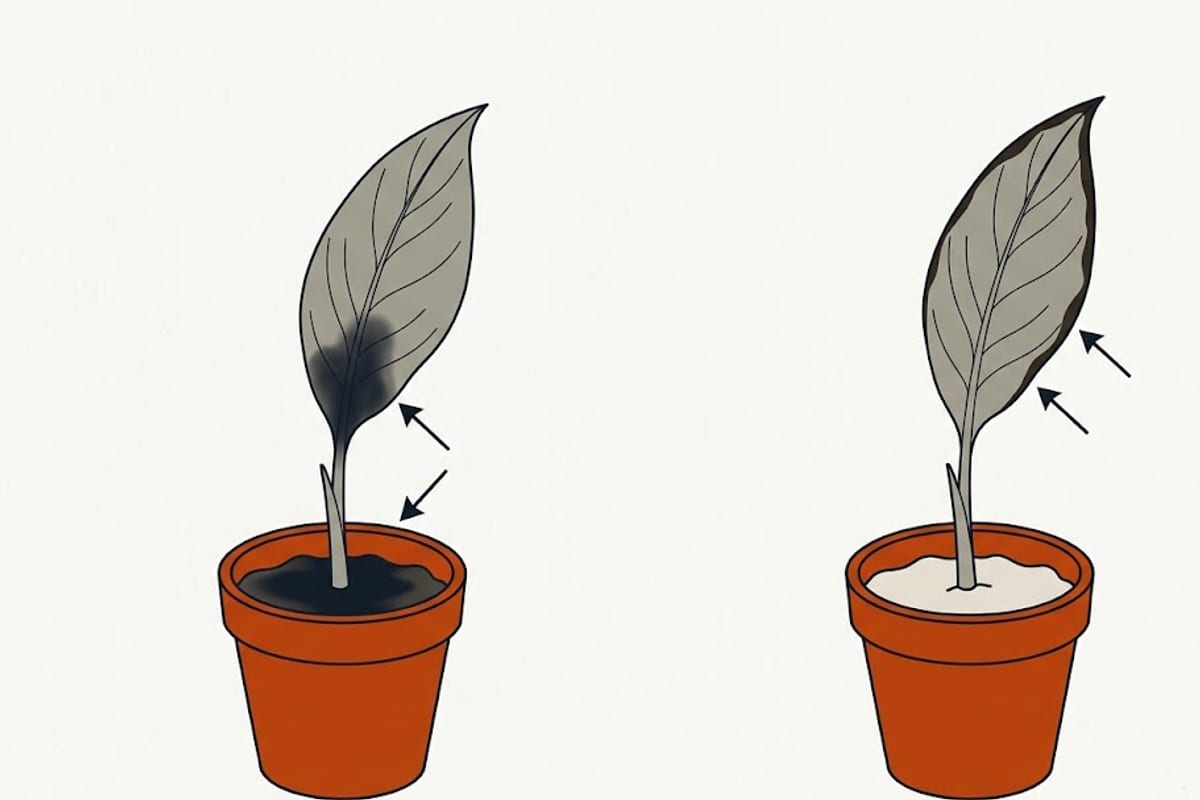
Root rot from overwatering
In soil that stays wet, peace lily roots suffocate and rot, and the rot moves up into the base of the leaf stalks. The stalks darken and soften at the soil line, black patches spread up into the lowest leaves, the leaves go limp, and the pot smells sour. The soil is wet days after watering. Several leaves are affected at once.
What to do: slide the plant out. Healthy roots are white to pale tan and firm; rotted ones are brown or black, soft, and slide apart. Cut every rotted root and every leaf that is soft at the base, back to firm tissue. Remove the old soil. Repot in fresh airy mix in a pot with drainage, no larger than the roots need, water once to settle it, and then not again until the top of the soil is dry. If the crown at the centre has gone black and soft, separate any healthy side shoots with their own roots and pot those.
Cold damage
Peace lilies come from warm forest floors and are damaged below about 15 degrees Celsius. A night on a cold windowsill, a draft from an outside door, or a cold room in winter turns patches of leaf soft, dark and translucent within a day, and those patches blacken and dry over the following days. The soil is not necessarily wet.
What to do: move the plant away from cold glass and drafts to a spot with steady warmth. Cut off leaves that are mostly blackened; leaves with small patches can stay. New growth is unaffected.
Fertiliser salts and tap water
Peace lilies are sensitive to fertiliser salts and to chlorine and fluoride in tap water. The tips and edges brown and blacken in a dry crisp line, often with a yellow band inside the black, on many leaves, and a white crust shows on the soil surface after feeding.
What to do: flush the pot with plenty of water until it drains clear, feed at quarter strength only in spring and summer, and water with rainwater, distilled or filtered water. Existing marks stay; new leaves come in clean.
Sun scorch
Direct sun through glass burns dry blackish-brown patches into the leaves that face it, sometimes with a bleached zone around them. What to do: move to bright indirect light, an east window or back from a south one.
Fungal or bacterial leaf spot
Infections produce scattered dark spots, often with yellow halos, sometimes wet-looking at first, that keep appearing on new leaves over weeks. Wet foliage, still air and a plant already weakened by overwatering favour them.
What to do: remove the worst leaves, stop wetting the foliage, water the soil in the morning, improve air movement, and let the top of the soil dry between waterings. A fungicide labelled for houseplants slows a fungal spread; bacterial spots are controlled by keeping the leaves dry.
A flower finishing
The white spathe of a peace lily flower lasts a few weeks, turns green, then browns and blackens from the edges as it finishes. The leaves are unaffected. What to do: cut the flower stalk at the base once the spathe has browned; the plant flowers again in good light.
The root check
Whenever the black is soft and the soil is wet, look at the roots before anything else. Tip the pot, support the crown, slide the root ball out. White and firm is healthy; brown or black and soft is rot, and the repot above is the fix.
What to do today, by cause
- Root rot: unpot, cut away rotted roots and soft leaves, repot in airy mix, water only when the top is dry.
- Cold: move to steady warmth, remove mostly blackened leaves.
- Salts or tap water: flush the pot, feed rarely, use softer water.
- Sun scorch: move to bright indirect light.
- Leaf spot: remove the worst leaves, keep foliage dry, improve air.
- Finished flower: cut the stalk at the base.
Frequently asked questions
Why are my peace lily leaves turning black and mushy?
Because the roots have rotted in wet soil and the rot has reached the leaf stalks, or because the plant was chilled. Wet soil, a sour smell and black spreading up from the stalk bases is rot; black patches appearing overnight after a cold night is chill. Rot needs unpotting and trimming today.
Should I cut black leaves off a peace lily?
Cut off leaves that are soft and black at the base, leaves that are mostly blackened, and leaves with spreading infection spots. A leaf with a dry black edge and plenty of green can stay; trim the edge for appearance if you like.
Why is my peace lily flower turning black?
Because it is finishing. The white spathe turns green, then brown, then black over a few weeks after opening. Cut the stalk at the base once it browns; new flowers follow in good light.
Can a peace lily recover from black leaves?
Yes, if the roots or at least some healthy side shoots are intact. Trim the rotted parts, repot in fresh mix, keep it warm and out of direct sun, and water only when the top of the soil is dry. New leaves appear within a few weeks.