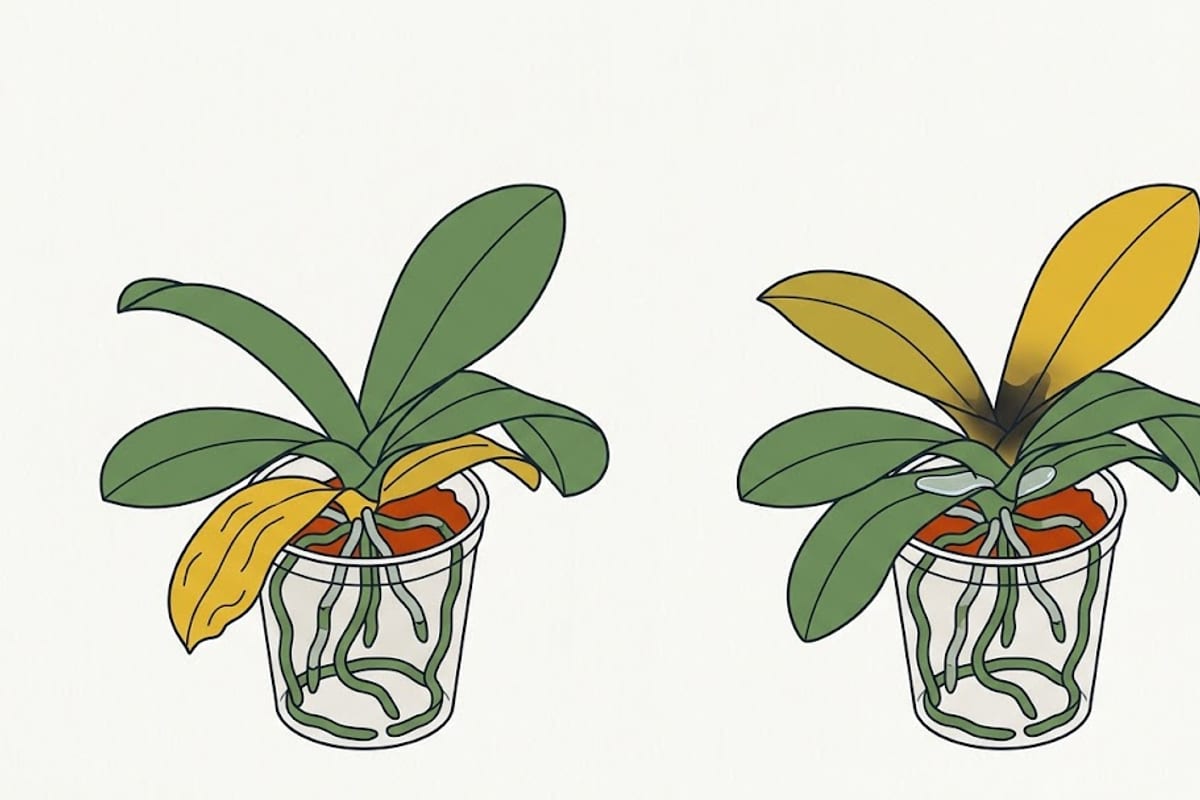
Orchids sold as houseplants are mostly phalaenopsis, and a phalaenopsis yellows a leaf for five reasons that its leaf position sorts out. The lowest, oldest leaf yellowing and dropping while the rest stay firm is normal shedding. Leaves yellowing from the middle of the plant, with wrinkling, point at roots that have rotted in soggy bark or dried out in old bark. The newest leaf at the top yellowing and softening at its base is crown rot, from water left sitting in the centre of the plant, and it is the one emergency on this page. Bleached yellow patches on the leaf facing the window are sunburn. Yellow and soft after a cold night is chilling.
Look at which leaf is yellow, whether it is firm or soft, and, since most orchids come in clear pots, what the roots look like.
What the leaf position tells you
| What you see | Most likely cause | Check this first |
|---|---|---|
| The lowest, oldest leaf yellowing evenly and wrinkling, everything above firm, roots healthy | Natural shedding | Nothing else changed |
| Middle leaves yellowing and wrinkling, roots brown, flat or mushy, bark dark and wet | Root rot from overwatering or old bark | Roots through the pot |
| Middle leaves yellowing and wrinkling, roots silver and shrivelled, bark dry | Underwatering | Roots and bark dryness |
| Newest top leaf yellow and soft or dark at its base, centre of the plant wet or discoloured | Crown rot | Water in the crown; smell |
| Pale bleached yellow patch on the side of a leaf facing the window, sometimes with a brown centre | Sunburn | Hours of direct sun |
| Yellow and soft or translucent leaves after a cold night or a draft | Cold damage | Where the plant sat |
Natural shedding
A healthy phalaenopsis carries four to eight leaves and lets the oldest go as it makes a new one. The bottom leaf yellows evenly over a week or two, wrinkles, and detaches. The leaves above stay firm and green, the roots are healthy, and a new leaf is usually forming at the top. Nothing is wrong.
What to do: leave it until it comes away with a gentle tug, or cut it at the base once fully yellow.
Root rot from overwatering or old bark
Phalaenopsis roots need air. In bark that stays wet, or in old bark that has broken down into a dense mush, the roots suffocate and rot. The plant can no longer take up water, and the leaves in the middle of the plant yellow, wrinkle and go limp. Through the clear pot the roots look brown, flat, hollow or mushy instead of plump and green or silver, and the bark is dark and smells sour.
What to do: unpot the plant. Cut away every brown, hollow or mushy root with clean scissors, back to firm tissue. Remove all the old bark. Repot in fresh orchid bark in a clear pot with drainage. Water by soaking the pot for fifteen minutes about once a week, when the roots have turned silver and the bark is dry, and let it drain fully. Keep the plant warm and bright while new roots form, which takes several weeks. Leaves that yellowed are lost; firm ones recover their plumpness slowly.
Underwatering
An orchid that goes dry too long yellows and wrinkles its middle leaves too, but the roots through the pot are silver, shrivelled and firm rather than brown and soft, and the bark is bone dry. What to do: soak the pot in room-temperature water for fifteen to twenty minutes, drain, and repeat weekly until the leaves firm up. Deep wrinkles may stay; the plant recovers over weeks.
Crown rot
Water that sits in the crown, the centre of the plant where the newest leaf emerges, rots the growing point. The top leaf yellows and softens at its base, the crown darkens and may smell, and the rot spreads downward through the stem. This is the one yellow leaf that needs action today, because an orchid grows only from its crown.
What to do: tip the plant to drain the crown and dry it with a tissue. If the newest leaf pulls away easily and the tissue beneath is dark and soft, the crown is rotting. Dab the area with a cotton swab of hydrogen peroxide or ground cinnamon, keep the crown dry, and improve air movement. If the rot has not reached the stem, the plant may produce a side shoot (a keiki) from a node lower down over the following months and survive that way. Prevent it: water at the pot, not over the leaves, and never leave water in the crown.
Sunburn
Phalaenopsis grows in shade under trees. Direct sun through glass bleaches the leaf that faces it to pale yellow and, with more exposure, burns a brown patch in the centre of the bleached area. What to do: move the plant to bright indirect light, an east window or back from a south one. The mark stays; new leaves are fine.
Cold damage
Below about 15 degrees Celsius for a night, or in a cold draft, orchid leaves go soft, yellow and translucent in patches, often within a day. What to do: move the plant to a warm spot away from cold glass. Damaged patches are lost; a leaf that is mostly firm can stay.
The root check through the pot
Most orchids are sold in clear pots for this reason. Healthy roots are plump, green when wet and silver when dry, with green growing tips. Rotted roots are brown, flat, hollow or stringy. Dehydrated roots are silver, thin and wrinkled but firm. The bark should be loose, light and dry between waterings; dark, soggy, crumbling bark needs replacing.
What to do today, by cause
- Natural shedding: leave the leaf and change nothing.
- Root rot: unpot, trim dead roots, repot in fresh bark, soak weekly only when dry.
- Underwatering: soak fifteen minutes, drain, repeat weekly until firm.
- Crown rot: drain and dry the crown, treat, keep it dry, hope for a side shoot.
- Sunburn: move to bright indirect light.
- Cold: move to a warm spot.
Frequently asked questions
Should I cut yellow leaves off an orchid?
The bottom leaf comes away on its own once fully yellow; you can leave it or cut it at the base. Leaves elsewhere that are fully yellow can be cut at the base with clean scissors. Do not pull a leaf from the crown; if the top leaf comes away easily, the crown is rotting and needs the treatment above.
Can a yellow orchid leaf turn green again?
No. A leaf that has turned yellow does not recover its colour. What recovers is the plant: firm leaves regain plumpness once the roots are sorted, and new leaves grow from the crown.
Why is my orchid's top leaf turning yellow?
Because water has been sitting in the crown and the growing point is rotting. This is the one yellow leaf that is urgent. Drain and dry the crown, treat it, keep water off the leaves from now on, and watch for a side shoot lower on the stem.
Why are my orchid leaves turning yellow and wrinkling?
Because the roots are not supplying water, either because they have rotted in soggy or old bark, or because the plant has gone too dry. Look at the roots through the pot: brown and mushy means repot; silver and shrivelled means soak.