A monstera leaf turns yellow for one of six reasons, and the plant tells you which by where the yellow appears, how fast it spreads, and what the soil feels like under your finger. Too much water is the most common by a wide margin. Old age, too little light, exhausted soil, pests and a recent move account for the rest.
Before changing anything, look at three things: which leaf is yellow (the oldest one at the bottom, or leaves throughout the plant), whether the stems feel firm or soft, and whether the soil two or three centimetres down is wet or dry. Those three observations, with the root check further down this page, sort out almost every case.
What the pattern of yellowing tells you
| What you see | Most likely cause | Check this first |
|---|---|---|
| One of the lowest, oldest leaves turning yellow, everything else firm and green | Natural leaf aging | Nothing else changed; new growth healthy |
| Several leaves yellowing at once, from the edges inward, stems soft, soil wet days after watering | Overwatering, roots suffocating or rotting | Soil moisture below the surface; smell of the pot; root check |
| Leaves yellow and limp, edges crisp and brown, soil bone dry and pulled from the pot | Underwatering | Weight of the pot; soil gap at the rim |
| Whole plant slowly paler, new leaves small with few or no splits, long bare stems | Too little light | Distance from the window; time of year |
| Older leaves yellowing evenly across the leaf, plant in the same soil for years | Nutrient shortage | Last feed; last repot |
| Yellow speckling or patches with fine webbing, sticky film, or cottony spots | Pests | Undersides of leaves and the leaf joints |
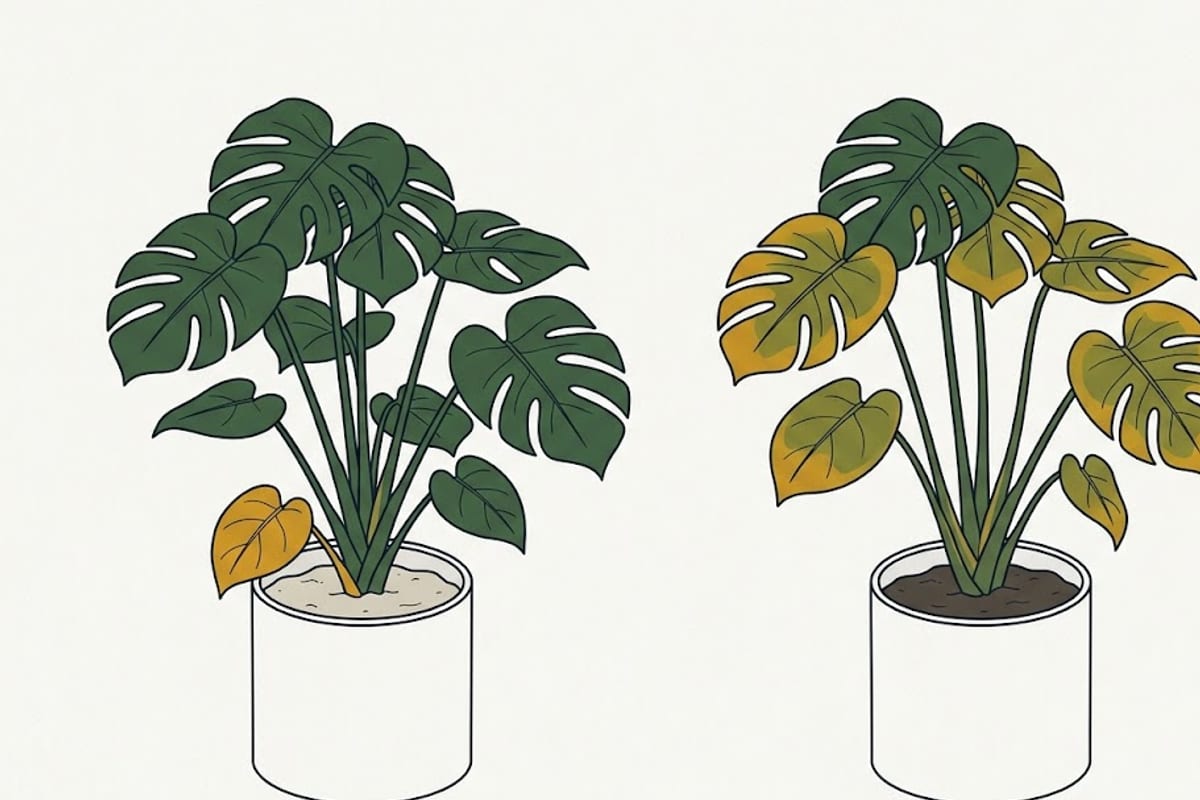
Overwatering and root rot
Monstera roots need air as much as water. In soil that stays wet, the air pockets fill, the roots suffocate, and the fine feeder roots die first. Fungi and bacteria move into the dead tissue and the rot spreads up into the larger roots and, eventually, the base of the stem.
The leaves report it before the roots are visible. Because damaged roots cannot move water and nutrients, several leaves yellow at once, usually starting at the edges and spreading inward, sometimes with dark brown or black blotches in the yellow. Stems near the soil feel soft. The pot smells sour or swampy when you put your nose to it. The soil is still wet three or four days after watering.
What to do: slide the plant out of the pot and look at the roots. Healthy monstera roots are white to tan, firm and slightly springy. Rotted roots are brown or black, soft, and slide off their core when you pinch them. Cut every mushy root back to firm tissue with clean scissors. Shake off the old soil. Repot in a fresh, airy mix (potting soil with a good share of bark or perlite) in a pot with a drainage hole, no larger than the root ball needs. Water once to settle the mix, then not again until the top few centimetres are dry. Remove leaves that are more than half yellow; they will not recover and the plant does not need them.
Recovery: new roots form in two to four weeks in warm bright conditions. Expect no new leaves until then. A plant whose stem base has gone soft is usually past saving, though a healthy growing tip with an aerial root can be cut and rooted in water.
Underwatering
A monstera that goes dry for too long yellows too, but differently. The leaves droop first, then yellow, and the edges and tips turn brown and crisp rather than soft. The soil is dry to the bottom of the pot, the pot is light, and often the soil has shrunk away from the pot's edge so that water runs straight down the gap without wetting the root ball.
What to do: water thoroughly, slowly, until it runs from the drainage hole, then let the excess drain. If the soil has shrunk from the rim, stand the pot in a basin of water for twenty to thirty minutes so the root ball rewets from below. Then check the soil by finger every few days rather than on a fixed schedule. Leaves that drooped from thirst usually stand back up within a day; yellowed ones will not turn green again but the crisping stops.
Too little light
Monsteras tolerate a dim room for a long time before showing it, which is why the light problem creeps up. In too little light the plant cannot support all its leaves, so it withdraws nutrients from older ones and lets them yellow slowly, while new leaves come in small, pale and without the splits and holes the plant is grown for. Stems stretch toward the window and the gaps between leaves lengthen.
What to do: move the plant to bright indirect light, a metre or two from a large window, or in front of a north or east window. Avoid several hours of hot direct afternoon sun through glass, which bleaches and scorches the leaves. Improvement shows in the next new leaf rather than in the old ones.
Nutrient shortage and old soil
A monstera that has sat in the same soil for two or three years without feeding runs out of nitrogen, and it shows as an even yellowing of the older leaves while the newest leaves stay green. Growth slows. The soil is often compacted and drains poorly, which makes overwatering more likely at the same time.
What to do: feed at half the strength on the label once a month through spring and summer, or repot into fresh mix one size up if the roots fill the pot. Do not feed a plant that is yellowing from rot or drought; feeding a damaged root system burns it.
Pests
Spider mites leave a fine pale stippling on the leaf surface and, in numbers, thin webbing at the leaf joints and undersides. Mealybugs look like white cottony specks in the leaf axils. Scale sits as small brown bumps along the stems and midribs. Thrips leave silvery streaks and tiny black droppings. All of them suck sap, and the leaf yellows in patches around the damage.
What to do: check the undersides of leaves and the joints with a light. Wipe leaves and stems with a damp cloth, then treat with insecticidal soap or a diluted horticultural oil, repeating weekly for three or four weeks to catch the hatchlings. Isolate the plant from others until it is clean.
Natural leaf aging
Every monstera sheds its oldest leaves as it grows. One leaf at the bottom of the plant turns evenly yellow over a week or two and drops, while everything above it stays firm and green and the plant keeps producing new growth. This is not a problem and needs no change in care.
What to do: cut the leaf off at the base of its stalk once it is fully yellow, or let it fall.
A recent move or repot
A monstera moved to a new room, brought home from a shop, or repotted may drop one or two lower leaves within a couple of weeks as it adjusts. If the soil is neither wet nor bone dry and the new growth is fine, wait.
The two-minute root check
When the pattern says water and you are not sure which way, the roots settle it. Water the plant lightly if the soil is very dry (so the root ball holds together), then tip the pot on its side, support the base of the stems with your hand, and slide the root ball out.
Healthy roots are white, cream or tan, firm, and smell of soil. They may fill the pot in a dense mass, which is fine. Rotted roots are brown or black, soft or hollow, and smell sour. If most of the roots are firm, the problem was not overwatering; put the plant back and look at light and feeding. If many are soft, trim and repot as described above.
What to do today, by cause
- Overwatering: unpot, trim rotten roots, repot in airy mix, water only when the top is dry.
- Underwatering: soak thoroughly, rewet from below if the soil has shrunk, check by finger every few days.
- Too little light: move to bright indirect light and judge by the next new leaf.
- Nutrient shortage: feed at half strength monthly in the growing season, or repot.
- Pests: inspect undersides, wipe, treat weekly for a month, isolate.
- Natural aging or a recent move: remove the yellow leaf and change nothing.
Frequently asked questions
Should I cut off yellow monstera leaves?
Yes, once a leaf is more than half yellow. It will not turn green again and the plant spends nothing on it. Cut the leaf stalk near the main stem with clean scissors. Leave leaves that are only slightly yellow at the edges until you have fixed the cause; they may stop yellowing where they are.
Can a yellow monstera leaf turn green again?
No. Once the green pigment in a leaf has broken down it is not rebuilt. What recovers is the plant: new leaves come in green once the cause is fixed. A leaf that is yellow only at the edges can stop yellowing and hold its remaining green.
Why are my monstera leaves turning yellow after repotting?
Usually one of two things: the new pot is much larger than the old one, so the soil stays wet for too long and the roots suffocate, or the roots were damaged during the move. Check the soil moisture below the surface. If it is still wet days after watering, the pot is too big or the mix too dense; if the soil is fine, give the plant a few weeks in one bright spot.
How often should I water a monstera?
There is no correct number of days. Water when the top two or three centimetres of soil are dry to the touch, thoroughly, until water runs from the drainage hole, and then not again until it dries to that depth. In a bright warm room that may be weekly; in a cool dim room in winter it may be every three or four weeks.