A monstera curls its leaves to reduce the surface losing water when water is short at the leaf. Water can be short for opposite reasons: there is none in the pot, or the roots have been damaged by rot and cannot take up what is there. Dry hot air, cold, a recent move and a few pests curl leaves too, and every new leaf unfurls from a tight curl over several days, which is not a problem.
The shape of the curl and the state of the soil tell them apart. Leaves rolling inward along their length and drooping are short of water. Edges curling under with crisp brown margins are drying in hot dry air. Curl only on the newest leaf is a leaf still opening.
Why a monstera curls its leaves
Water leaves a monstera leaf through pores on its underside faster than the roots can replace it, and the leaf rolls to shrink the surface doing the losing. The roots fall behind when the soil is dry, when the roots are dead, or when the air is pulling water out of the leaf faster than any roots could keep up.
Inward curl with limp leaves: not enough water reaching the leaf
This is the common curl, and it has two opposite causes with the same look. In dry soil the roots have nothing to draw on, and the leaves roll inward and droop. In wet soil with rotted roots, the roots cannot draw on the water around them, and the leaves roll inward and droop just the same, with lower leaves yellowing and the pot smelling sour.
What to do: feel the soil a few centimetres down and lift the pot. Dry and light means water thoroughly, and rewet from below if the soil has shrunk from the pot rim; the leaves flatten within a day. Wet and heavy means slide the plant out, trim brown mushy roots back to firm tissue, repot in fresh airy mix, and water only when the top of the soil is dry; the leaves flatten over a couple of weeks as new roots form.
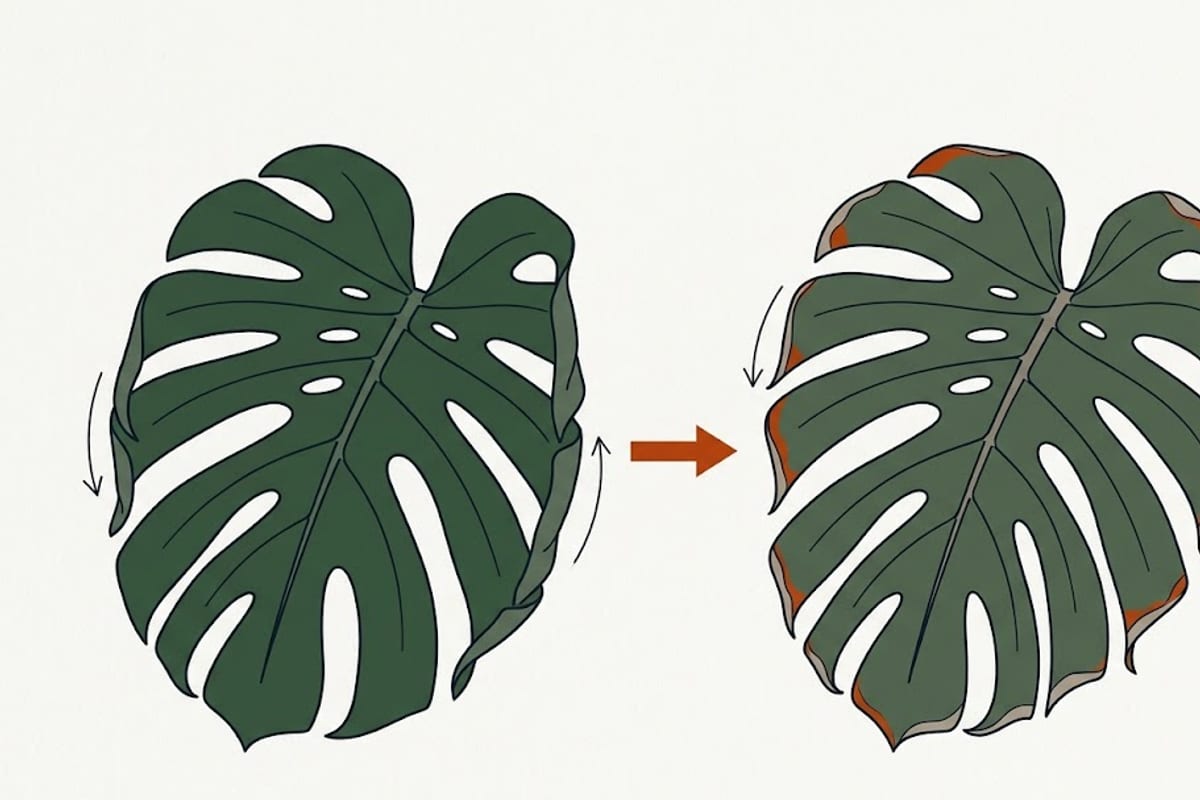
Curl under with crisp brown edges: heat and dry air
Near a radiator, a heating vent, a fireplace or hot glass in summer, the leaf edges dry faster than the leaf can supply them. They brown in a thin crisp line and curl downward and under, while the soil may be perfectly moist. The marks are on the leaves nearest the heat.
What to do: move the plant away from the heat source or filter the sun with a sheer curtain. Group plants so they share moisture, stand the pot on a tray of wet pebbles, or run a humidifier in a very dry room. Misting wets the leaf for a few minutes and does not change the air; it is not a fix. Existing brown edges stay; new leaves come in flat.
Curling on new leaves only
Every new monstera leaf emerges tightly rolled and unrolls over several days to a week. If the older leaves are flat and only the newest is curled, wait. A new leaf that stays rolled for weeks, or opens small and creased, was short of water or in dry air while it was opening, or has a pest feeding on it.
Curling after repotting or moving
A monstera repotted, moved to a new room or brought home may curl and droop for a week or two while the roots re-establish and the leaves adjust to different light and humidity. The soil is neither wet nor bone dry.
What to do: keep it in one bright spot, water when the top of the soil is dry, and wait two weeks.
Pests that cause curling
Thrips leave silvery streaks and tiny black specks and distort new leaves. Spider mites leave fine pale stippling and, in numbers, webbing at the leaf joints. Mealybugs sit as white cottony specks in the axils. All feed on sap and curl the leaves they feed on.
What to do: check the undersides and the joints with a light, wipe the plant down, treat with insecticidal soap or horticultural oil on both leaf surfaces, repeat weekly for a month, and isolate the plant.
The three checks that separate the causes
| What the check shows | What it means | What to do |
|---|---|---|
| Finger or skewer dry to depth, pot light | Underwatering | Water thoroughly, rewet from below if the soil has shrunk |
| Soil wet at depth days after watering, pot heavy, sour smell | Overwatering and root rot | Unpot, trim rotted roots, repot in airy mix, water less |
| Soil moist, edges crisp, plant near heat or hot glass | Dry air or heat | Move away from the heat, raise humidity |
| Soil moist, roots white and firm, plant recently moved | Shock | Wait two weeks in one spot |
| Roots brown, soft, slide apart | Rot | Trim and repot |
What to do today, by cause
- Underwatering: soak thoroughly, rewet from below if the soil has shrunk, check by finger every few days.
- Root rot: unpot, trim, repot in airy mix, water only when the top is dry.
- Heat and dry air: move away from heaters and hot glass, raise humidity.
- New leaf: wait a week.
- Shock: leave it in one spot for two weeks.
- Pests: inspect, wipe, treat weekly for a month, isolate.
Frequently asked questions
Will curled monstera leaves uncurl?
Leaves curled from thirst flatten within a day of a thorough watering. Leaves curled from root rot flatten over a couple of weeks once the roots are trimmed and the plant is repotted. Leaves that curled under with crisp brown edges from dry air stay as they are; new leaves come in flat.
Should I cut curled leaves off?
Not for curling alone. A curled leaf still feeds the plant and usually flattens once the cause is fixed. Remove a leaf only if it is mostly yellow or brown.
How do I know if my monstera is overwatered or underwatered?
By the soil and the pot. Dry soil and a light pot with inward-curled drooping leaves is thirst. Wet soil days after watering, a heavy pot, yellowing lower leaves and curling is overwatering, and the roots will be brown and soft when you slide the plant out.
Does misting help a curling monstera?
No. Misting wets the leaf surface for a few minutes and does nothing for the roots or the room's humidity. Water the soil if it is dry, repot if the roots are rotted, and move the plant away from heat or use a humidifier if the edges are crisp.